

· News
Unity through Diversity: a motto that inspires educational cooperation
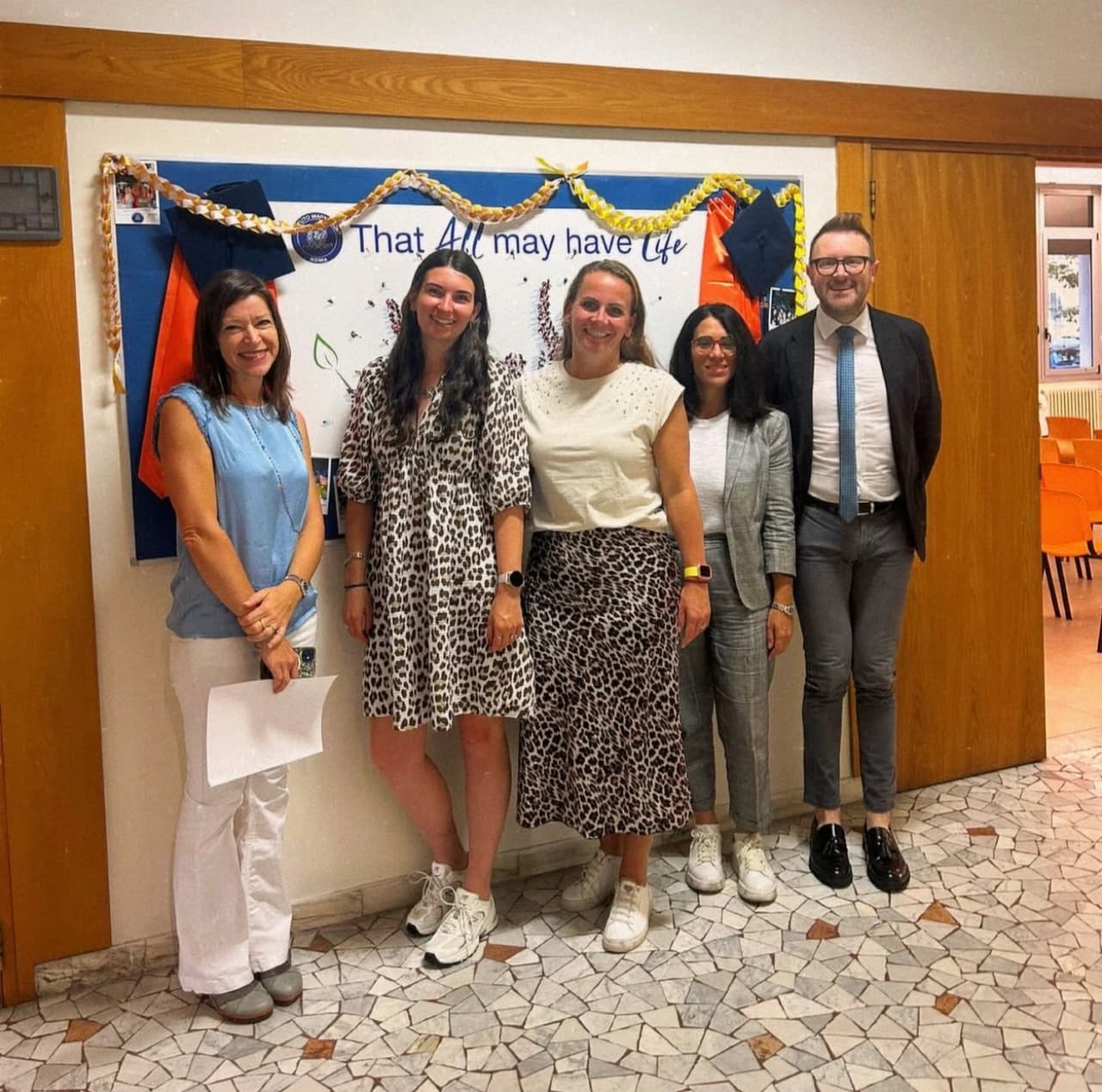
This is the lesson that Rianne Bish and Maaike Koomen, teachers at Vons Grootebroek High School in the Netherlands, left us during their visit to Rome in recent days as part of the Erasmus+ program: inclusion is a global educational challenge, one that involves educators in every democratic system. And it was precisely in the course of their search for somewhat virtuous models that the two Dutch colleagues came across our school as an example of how this principle translates into concrete everyday practices, capable of truly affecting students’ well-being.
During their stay, Rianne and Maaike took part in discussion groups with teachers and students and closely observed lessons in Italian and English, teaching methods, educational relationships and extracurricular activities, asking questions, sharing reflections and establishing an open dialogue that enriched both sides in a true exercise of educational cooperation and reciprocity.
On the sidelines of these two days, our Principal, Prof. Shane Grant, observed: “They were two very rich days. Knowing that other educational systems in Europe are also asking themselves questions, and finding themselves facing epochal challenges just as we are, makes us feel less alone. It reminds us that we are all part of a profound change in the way we care for adolescents during their school years. And Istituto Marymount, as always, is at the forefront in seeking concrete and meaningful answers to the educational needs of our time.”
“One of the aspects that struck me most in the two teachers’ accounts,” Prof. Grant continues, “was the rigid division of students by learning level that their system already requires at the end of primary school (corresponding to our first-year Middle School – Grade 6), which inevitably places limits on each student’s chance to then fully express their potential, grow at their own pace and find alternative ways to learn and develop. I found some of their curricular choices very interesting, on the other hand, such as including among the compulsory subjects fundamental practical skills like cooking or caring for animals. Here is a particularly significant example: during school holidays, students take care in person, on a rotating basis, of the animals kept at the school, an activity that strengthens the sense of responsibility and of belonging to the school community.”
“The two colleagues,” Prof. Grant continues, “were very struck by the warm and respectful way our students behave toward their teachers and vice versa. They asked us what our secret is, and my answer was very simple: what guides us every day are principles such as Unity through Diversity and That All May Have Life, the founding pillars of our school, which embody the values of the Religious of the Sacred Heart of Mary. This is exactly why we cannot accept that a student should walk through the school gate in the morning and feel unhappy simply because they are here. Fortunately, the profile of our teachers fully reflects these values. It is thanks to our cohesive educational community, made up of teachers, students, parents and leadership, that we can support one another and truly make a difference, both inside and outside the classroom.”
The dialogue then naturally focused on the theme of inclusion, addressed broadly: from the integration of students from different countries or language backgrounds to support for those experiencing personal hardship. On this point we heard from Prof. Linda Breda, our internal inclusion coordinator: “In the Netherlands, the school system is undergoing a transformation in a more inclusive direction, and the visit here with us was a useful piece for them in imagining how to make this trajectory concrete. Our Dutch colleagues also work with young people from different cultural backgrounds, with very varied life experiences and learning styles, and their goal is to create a school environment in which they can not only survive but, above all, flourish. We found ourselves in deep agreement when we observed that the most important thing is to slow down, to take the time to listen to one another, to communicate and to build that bond that can then turn into a relationship of trust and support. Only in this way can we create a safe environment in which everyone is not only accepted for who they are, but valued for the unique gifts they bring to our learning community.”
Another significant moment was the meeting with our philosophy teacher Matteo Mauro: “Both colleagues were very struck by how our context is oriented toward emotional welcome, active listening and the valuing of the person. The two guests noted with interest the low level of conflict among students and the lasting attachment of many former students to the school community, a sign of a deep bond that goes beyond the mere teaching experience. I also told them that our extracurricular activities such as seminars, art projects and the music band are important opportunities to strengthen bonds within the community, generating meaningful relationships founded on sharing and participation. Another topic we addressed together concerned the teaching of the humanities in a context as rich and stimulating as the one our city offers. Our integrated approach between the Italian and Anglo-Saxon educational traditions was also particularly appreciated, two perspectives to be brought into dialogue, bringing out both the differences and the possible points of contact.”