

· News
Not just Virgo, Mater, Vidua: 315 women authors tell a different Middle Ages
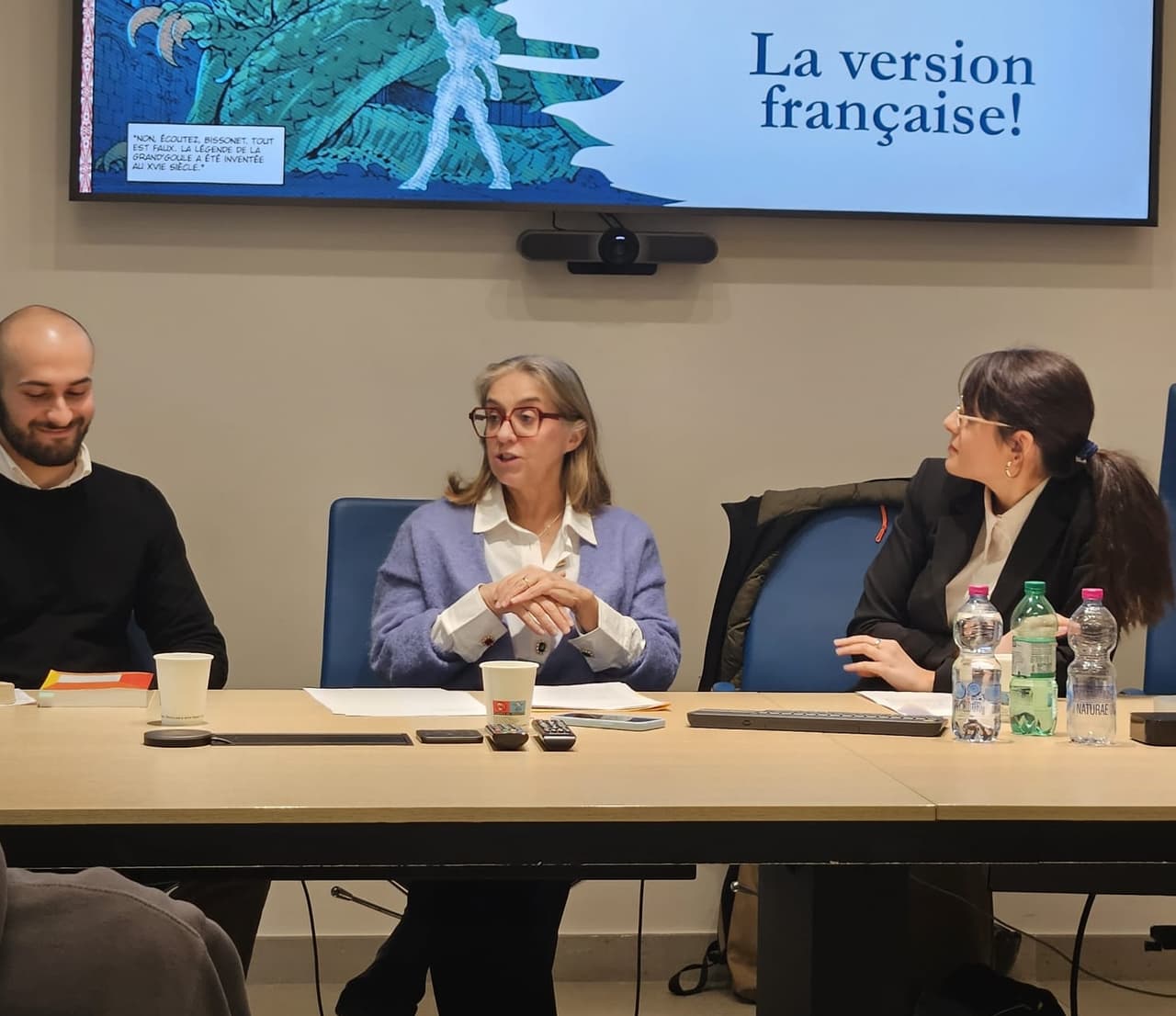
Medieval women writers are far more numerous than our literary history textbooks let on. Today the passionate work of philologists seeks to give them back a voice and to redress the ‘gynecide’ committed over so many centuries, as Margherita tells us after the meeting held at the High School last April 10.
A Babel-like, boundless chorus: this is how Prof. Donatella Manzoli, founder of the “MedioEvA” research center and professor of Medieval and Humanistic Literature at the “La Sapienza” University of Rome, describes the very large, though often forgotten, literary corpus produced by women authors over the medieval centuries. The “MedioEvA” project was created with the aim of compiling an annotated register of the many women authors who lived in Europe between the 6th and 15th centuries, so that a voice can be given back to the hundreds of women who were silenced by a literary prejudice still deeply rooted in our canon today.
A few days before the meeting, we students were invited by our teachers to leaf through the index pages of Greek, Latin and Italian anthologies in search of female literary identities. Names like Alda Merini, Amelia Rosselli and Elsa Morante represent only a tiny minority, and it is certainly no accident that the few women authors included in the compendia are twentieth-century ones. Western culture is deeply stained by the prejudice that our literary history is to be written only in the masculine, and only today, through research initiatives like the one promoted by Professor Manzoli, have new names and new stories, all in the feminine, emerged.
Although we are often inclined to associate the Middle Ages with a period of darkness and superstition, in reality the period between the 6th and 15th centuries was the backdrop to a particularly multifaceted and intense female literary output, in which women could write, read and draft manuscripts, thus disproving the commonplace of the medieval woman confined to the roles of virgo, mater, vidua. In this new perspective literature becomes an antidote to misogyny, because the voices of as many as three hundred and fifteen women authors tell a different Middle Ages, in which instead of Charlemagne one speaks of his sister Gisela, or the traditional authors of the canons are replaced by poets such as the Andalusian Wallada bint al-Mustakfi, whose compositions recount the cultural freedom of a now remote tradition.
Between medieval women authors and us modern readers, therefore, a relationship of undeniable continuity is established. The testimonies of strong women cannot help but be a model, a stimulus to claim a role in the arts, sciences and politics. One need only think, for example, of the story of Christina of Markyate, who lived in the 11th century during the clashes between Normans and Anglo-Saxons on the British island. Christina is an example of a strong, determined woman, whose life is sadly marked by attempts at abuse and mistreatment that nevertheless would never turn her away from her determination to embrace the anchoritic life. In a modernity still stained by systematic violence against women, stories of women like Christina of Markyate are a reason for hope and a model for generations of young women tired of enduring abuses of power and prejudice.
This is how “MedioEvA” makes us rediscover the Middle Ages, making us passionate about them and about their “army of women writers.” From Dhuoda, a Carolingian noblewoman and author of a work intended for her son’s education, to Aisha Bint Ahmad al-Qurthubiyyah, an Arab poet known for the aggressive vitality of her compositions, the women of letters of this period, who composed their texts in different languages, from Medieval Latin to Old French, from Arabic to Hebrew, give voice to thoughts and ideas that transcend temporal limits. It is by now time to atone for the intellectual gynecide committed over the centuries, so as to open ourselves to new horizons, so that women may finally experience literature as protagonists.
By Margherita Brizia Aprile, 18 years old, Marymount Classical High School
(The text of this article also appeared in the Marymount Express, the High School’s student newspaper)