· Primary School, Middle School
Getting in the Game with Numbers and Formulas
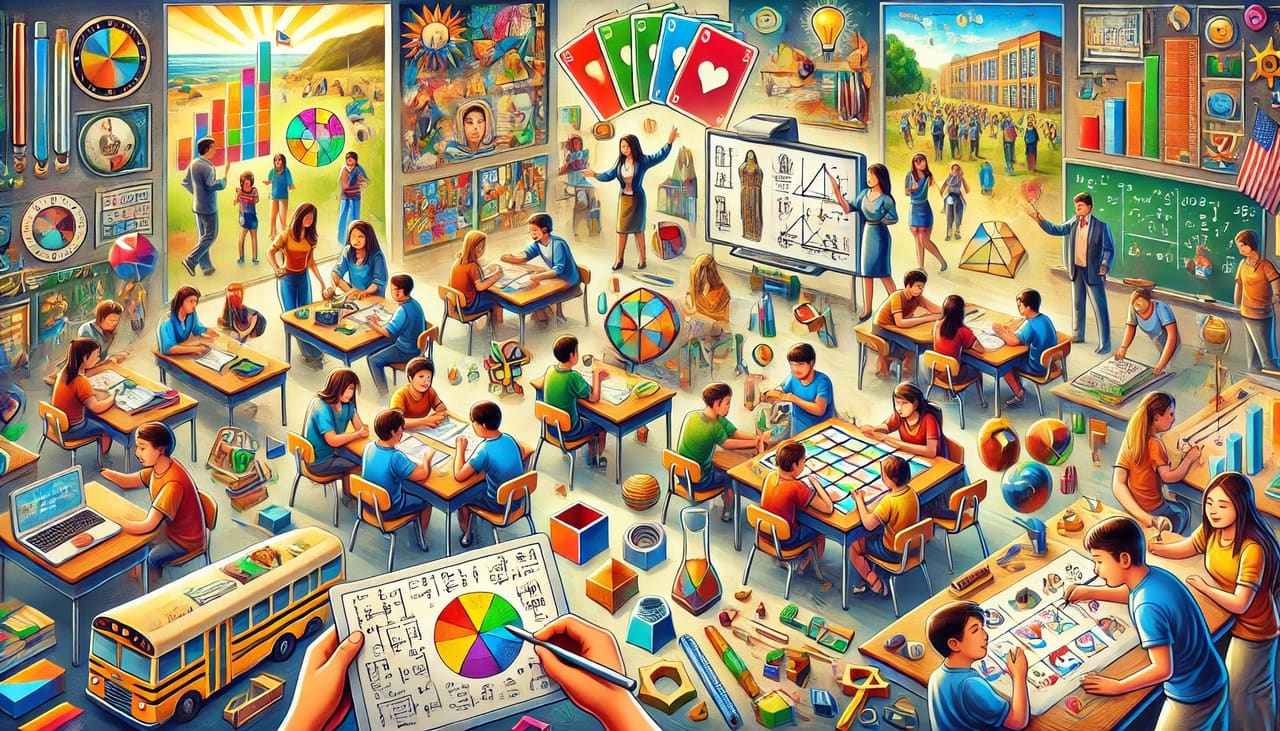
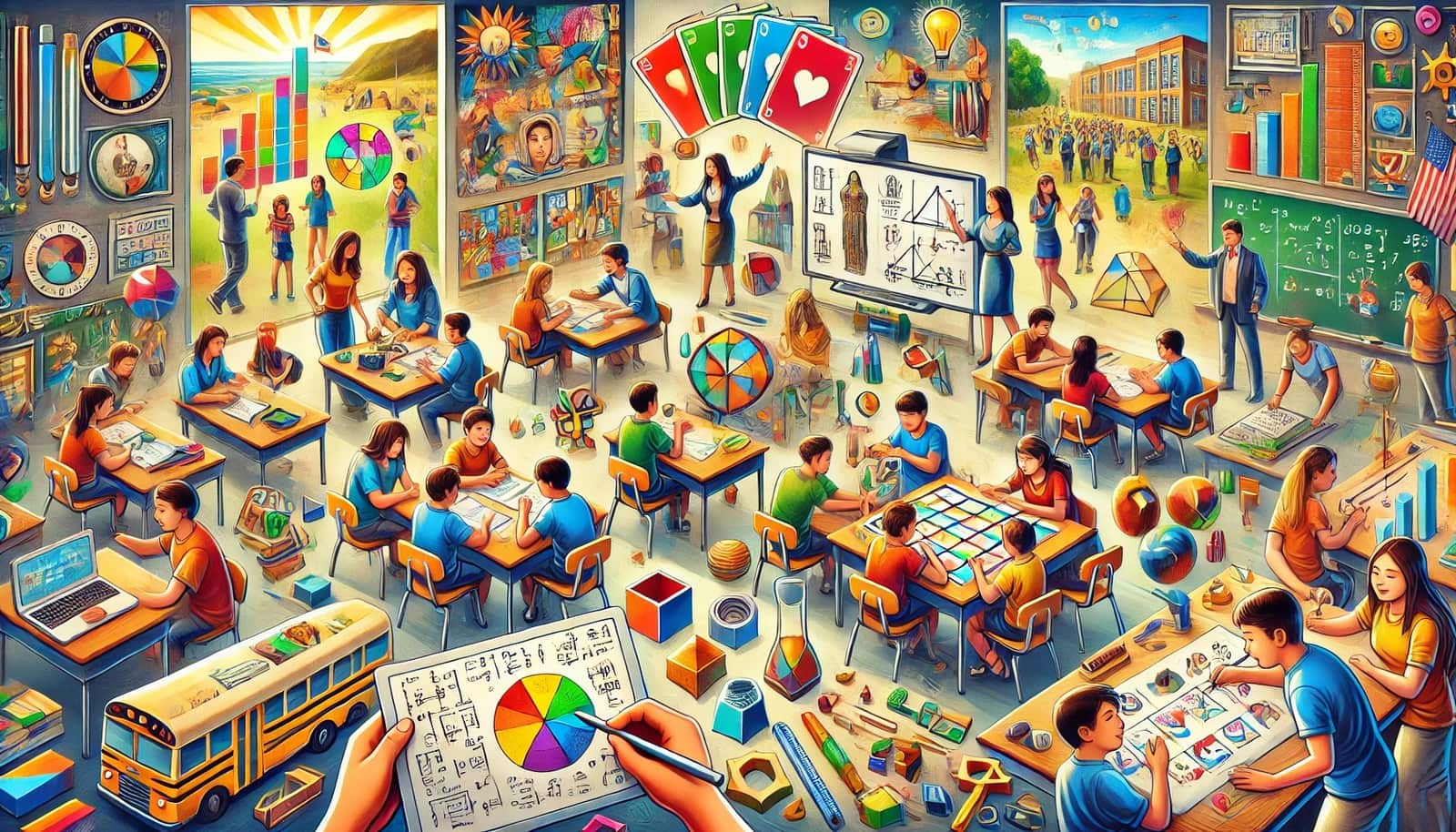
How do you counter aversion to math? And how do you encourage interest in formulas and theorems? Our Primary and Middle School teachers answer with colored cards, team games, and competitions. The goal is to convince us that math can truly become child’s play.
In recent years many multimedia tools have become part of teaching: textbooks boast digital resources for students, in-depth materials, exercise books, and platforms that allow online activities. All of this is useful and effective, but it remains essential not to neglect the connection with physical reality, which is also at the root of the primordial concepts of mathematics: number arises from the need to count head of livestock and food supplies, and the line simulates the rope stretched taut by the surveyor. “It is essential always to start from experience, to handle bottle caps, straws, pebbles. Approaching symbolic thought at school is unthinkable without the movement of the hands, without listening,” says Maura Ferritto, a Grade 2 teacher. “What interests us is fostering dynamic teaching, in which the body is one with thought. We never offer lecture-style lessons, the desks are arranged in islands, we always work in an environment of creation and problem solving, and we try to strengthen argumentative skills, always asking the children to explain why a certain strategy was used.” Walking through the school’s hallways during math hours, one almost feels as if one were in the mathematical workshop that Emma Castelnuovo spoke of already in the early postwar years, or hears again the words of Ana Millán Gasca, from her text “Numeri e Forme” (Zanichelli 2016): “Even in mathematics it is vital to look beyond pure numerical literacy and to be ready to accompany children on a journey through the fascinating landscape of mathematical concepts: fascinating because it is a journey made with the mind and the imagination but also with the body, observing and touching; because it passes through ever-new stages (new numbers, new shapes); and because, along the way, one discovers a multitude of connections between concepts, like a network of invisible threads that, instead of hiding the landscape, help children find their way through it.”
But the willingness to set out on a journey is also what distinguishes our Middle School students, whose classes IB, IA, and IIC took part this year in the final of the 6th edition of “Matematica per tutti” (Math for Everyone), the national team competition promoted by the Tokalon Association, which is based on an idea of playful and participatory math, an approach that adds surprise, fun, relationship, and sharing to traditional study.
“To prepare for this event we supplemented our curriculum plan with playful group activities,” says Professor Giulia Macciocco. “A real innovation, since we are all used to thinking of mathematical reasoning as an essentially solitary activity. Working in a group, instead, means learning to discuss and to critically argue one’s own strategies, while at the same time sharpening the skills of negotiation, leadership, and organization of one’s own and others’ work.” The teacher’s satisfaction becomes even more tangible when we ask her about the effects of these activities in terms of individual achievement: “Everyone has improved their performance and gained a greater awareness of their abilities. Many students, taken individually, would have been reluctant to try to solve the hardest questions, to put different strategies into practice, or to offer their own theory; in a group, instead, they understood that they could make a contribution, finding in the challenge a moment of fun but also of great personal growth.”
This new approach to formulas and numbers was brought to our Middle School by Professor Matteo Molinari, a member of the Tokalon Association who, trained under the guidance of the great historian of mathematics Giorgio Israel, insists on the idea of the historicity and humanity of this discipline: “It’s the first thing I tell the students: doing math does not mean doing calculations, but realizing that you are taking part in the same adventure that Pythagoras, Euclid, and Galileo lived. To understand nature in its deepest and most mysterious laws, they started from observation to deduce rules and arrive at a genuine modeling of reality, which is what we must try to do at school too, making use of all the tools we have available today. To explain that geometry is dynamic, for example, we use the concepts and tools of classical mathematics to then arrive at digital applications, which let us have a fuller idea of the movement of figures, of isometries, of rotation.”
And so, plenty of room for the history of mathematics, to understand that those who gave names to formulas and theorems were men with their ideas, passions, and feelings, and not algorithms or calculators.