

· High School
Legality, young people and anti-mafia culture
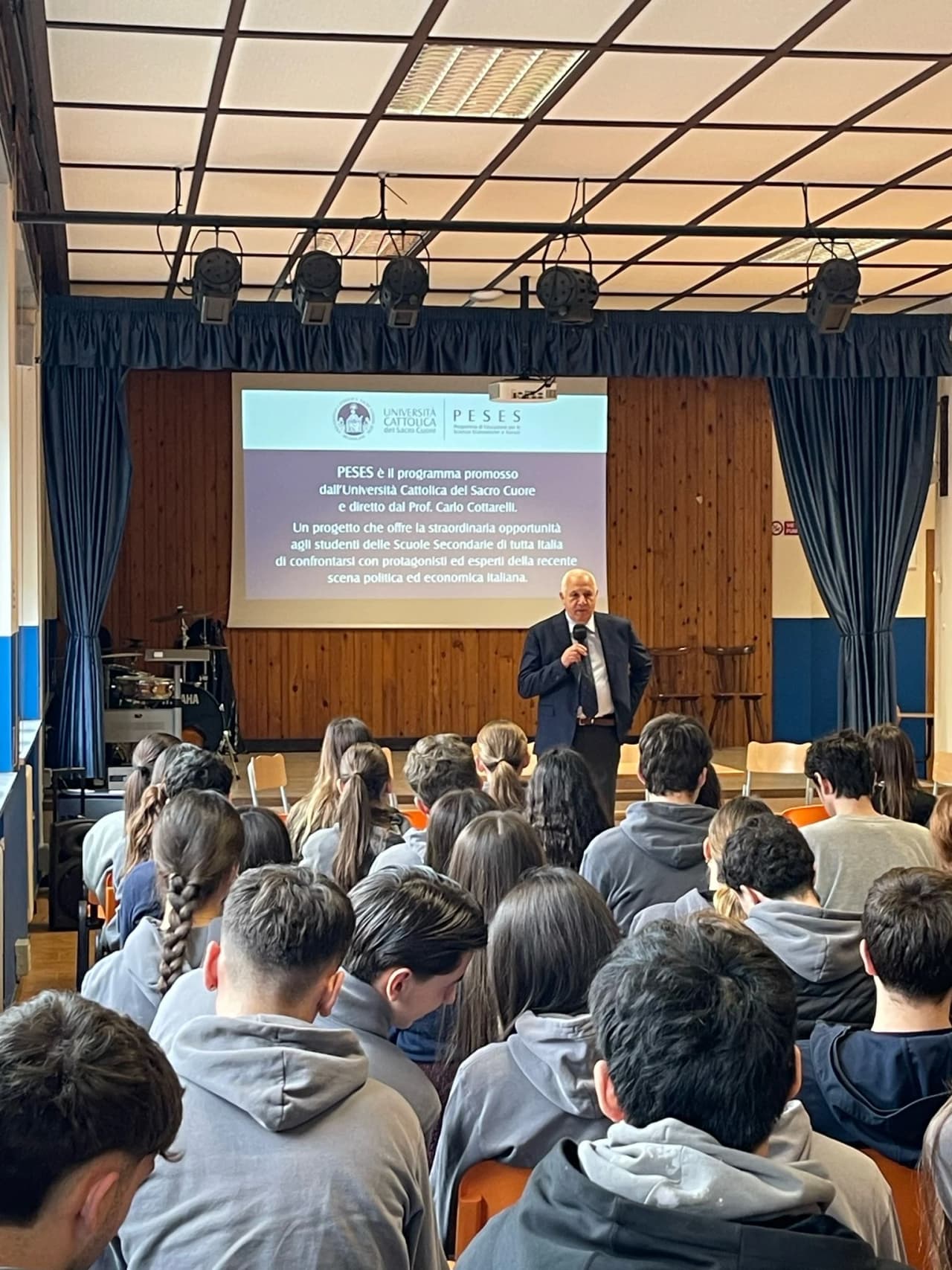
As part of PESES, the Education Program for Economic and Social Sciences of the Università Cattolica, the third-year High School classes took up the theme of the fight against crime together with Carabinieri General Teo Luzi, a man who has dedicated his life to the country’s security and to the fight against organized crime. A moment of great inspiration that Maria Sofia was able to capture and rework in this interview.
Making institutions known and strengthening young people’s trust in the constitutional values of fairness, justice and social cohesion is a purpose at the heart of every school’s educational mission. On February 19, we students of the High School were able to engage on these themes with a leading figure in the fight against organized crime in recent years, learning many things about his work in the service of the State and about his personal path, information that may perhaps inspire some of us in our own choices.
Born in Cattolica on November 14, 1959, and after an initial phase in which he imagined a future as a doctor, General Luzi began his military career by entering the Academy in Modena in 1978. From then on he held numerous prestigious posts within the Carabinieri, until becoming Commander General from January 16, 2021 to November 15, 2024. Over the course of his career he has received numerous honors, including the Menorah d’Oro, the Premio Nazionale Paolo Borsellino and the Premio Guido Carli.
At the end of a truly lively and well-attended meeting, here are the questions we asked him.
General, let’s start with a very topical phenomenon that involves precisely young and very young people: youth gangs. How do you interpret it, and how is it possible to think of a genuine social reintegration for those who are part of one?
“Baby gangs have always existed. What is new today is that they often originate on social media and that young people do not perceive the wrongness of certain violent behaviors. The phenomenon can be contained only through culture, by making young people understand that groups are negative when they are dominated by the myth of violence. Moreover, with very serious criminal consequences if those responsible are identified. In this, family and school can do a great deal to help young people grow up in a healthy environment. The State, too, must do its part by creating or fostering positive conditions for gathering together, such as in the sports, arts and environmental fields.”
Let’s move on to the fight against organized crime, the field in which you have particularly distinguished yourself and which we know is still one of our State’s priorities. What aspect has struck you most over these years?
“That the great majority of fugitives manage to elude the searches of the police forces – some for decades and decades – while remaining in their territory of origin. This was the case for Riina, Provenzano, Messina Denaro and many others. This is made possible above all by what we call social omertà (even, unfortunately, on the part of highly educated people). Omertà that is in part a consequence of the fear that comes from the intimidating force of organized crime.”
What do you think of the role of the pentiti (mafia turncoats)?
“The role of the pentiti is very important in the fight against crime, as it makes it possible to identify accomplices and to seize illicit assets. Today Italy has legislation that is efficient and, at the same time, protective of the rights of the accused. In fact, the statements of justice collaborators (collaboratori di giustizia), as the law precisely calls them, must always be corroborated by investigations.”
How has the mindset of the Italian population toward organized crime changed?
“Compared with the past, Italians are more aware that the mafia undermines the roots of society and the economy and that it damages the future of our young people. But we must not lower our guard. Attention must always remain high. It is therefore appropriate to talk about it constantly in the media, in schools and in every social center. Anti-mafia culture is the main antidote against organized crime.”
Finally, what really drove you to pursue a military career? Would you recommend it to young people today?
“Shortly before graduating, I imagined my future as a doctor and was thinking of enrolling in Medicine at the University of Bologna. By a magical touch of fate, one spring Sunday morning, in the square of my native town in Romagna, the Station Commander happened to mention to me the opportunity of becoming a carabiniere. A light went on in me, and in the following weeks I looked into this opportunity in depth. Attracted by the ethical values of such a choice and by the idea of working for the benefit of society, to protect security and legality, the idea of a military career matured in me. After 46 years I can say that I made the right choice and that being a Commander (at any rank, from lieutenant to general) is the most beautiful mission and has no equal. Many sacrifices, but unique satisfactions! For this reason I sincerely recommend that young people consider this opportunity and, if they are convinced, give it a try.”
Maria Sofia Vittimberga, 16 years old, Classical High School “Marymount” (journalism workshop)