

· Early Childhood
Kindergarten: our garden of talents
The last year of Early Childhood here at Marymount is an opportunity to explore in depth what interdisciplinary teaching really means. Educational robotics, art workshops and a first approach to the Chinese language stimulate children toward a rich, dynamic, future-oriented path of learning, one that will nurture within them the basic skills for the transition to Primary School.
Engaging five-year-olds in activities that train them in coding, STEAM subjects and interdisciplinarity might seem an ambitious educational choice in a school that has always made bilingualism its strength. And yet, here in our Kindergarten all of this has by now been established practice for quite some time, subject to the careful observation of the teaching staff and to the updates suggested by pedagogical research.
If they were to name the activity that, more than any other, characterizes this last year of Early Childhood, teachers and coordinators would have no doubt: besides English, it is the approach to computational thinking that makes the difference. It happens first of all through activities with Cubetto, a small robot that lets children learn the basics of coding in an intuitive and fun way, since the aim of the young learners is to program its movement without using digital devices.
Play therefore remains the great protagonist of our children’s days in Kindergarten, play being the main road to absorbing the first complex linguistic and mathematical concepts, such as word formation and matching numbers to quantities, with the aid of activities like Memory, Puzzle and Tangram, in both Italian and English, and of structured materials or natural and recycled elements. A school year thus conceived as a phase in which playful stimuli, exploration and relationships strengthen learning in a serene, stimulating, inclusive climate, and which represents a moment for strengthening the essential skills needed to continue on to Primary School, whose curriculum is naturally designed in continuity to foster the development of new cognitive and social tools.
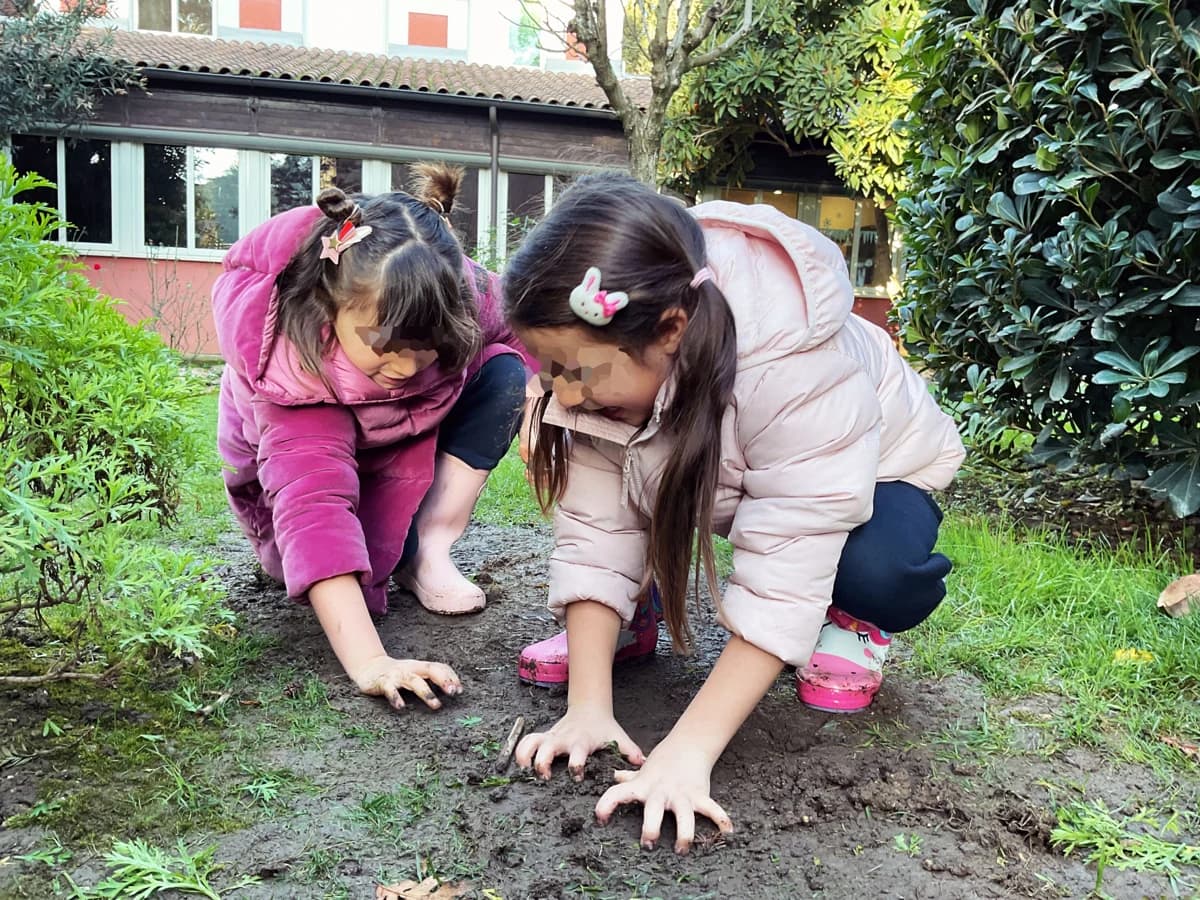
Giving further momentum to this rich educational offering are also the Outdoor learning activities – which stimulate curiosity and respect for the environment, preparing children for interdisciplinary learning across science, math and ecology – and the introduction of the study of the Chinese language, which enhances stimulation in the linguistic area and nurtures, from a tender age, an open and multicultural view of the world.
And it could not be otherwise, since our own educational proposal arises from the encounter of two worlds, two complementary pedagogical visions: the Anglo-Saxon constructivist one, pragmatic and scientific, and the Italian one, more humanistic and Montessori-inspired. In this context, the STEAM subjects find a natural connection with art: in the pavilions of our garden, true open-air classrooms, art workshops come to life that stimulate children’s creativity by introducing them to the language of representation, of colors, of shapes, of the great masters of the past and of the present.
For all these reasons, Kindergarten is the “children’s garden” where our talents grow.