· News
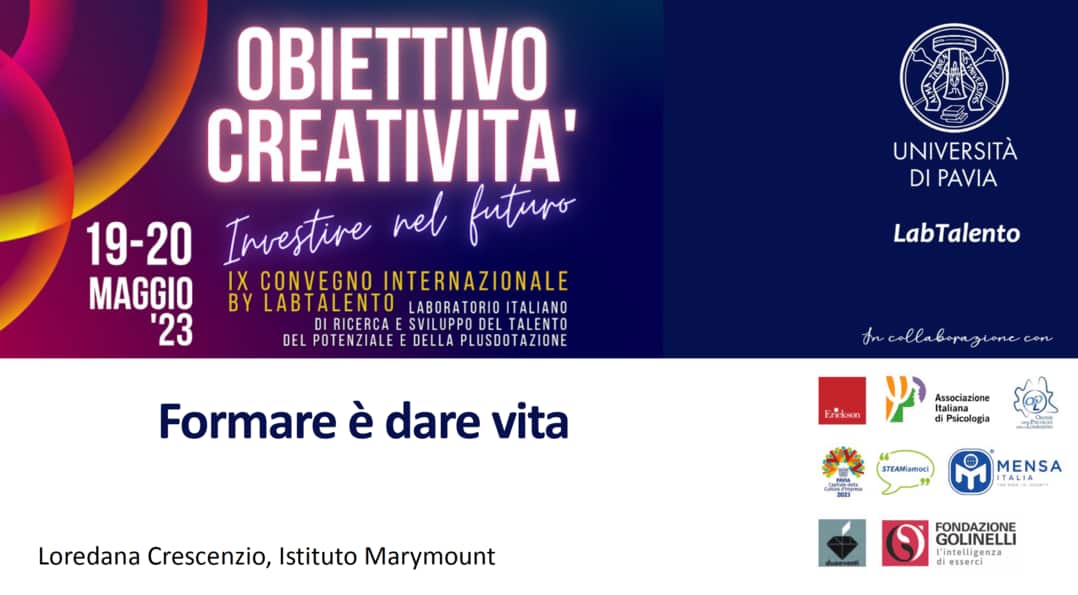
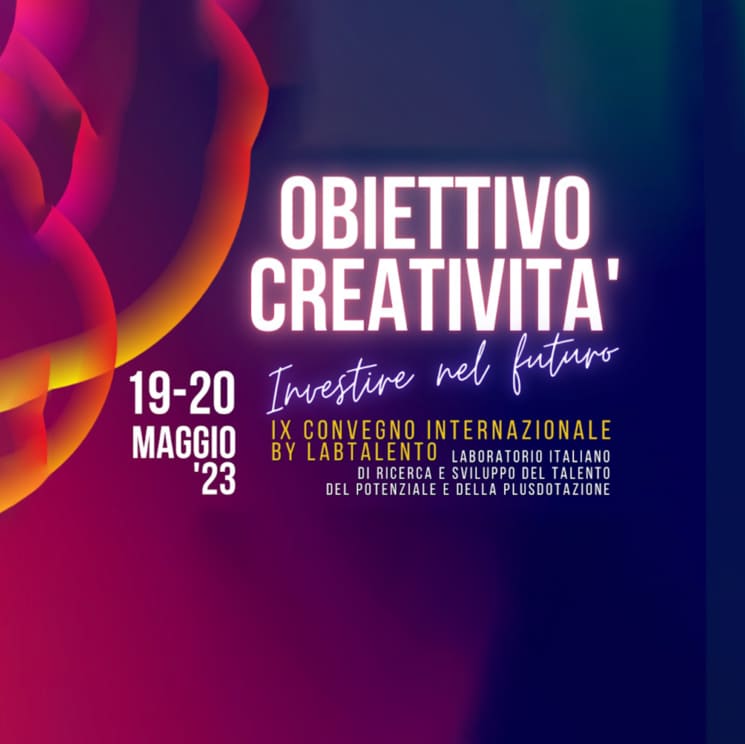
9th International Conference “Obiettivo Creatività: Investire nel futuro” (Objective Creativity: Investing in the Future)
What is creativity? How does it manifest itself? How is it nurtured in an educational setting such as school?
From problem posing to problem solving, in the perspectives and experiences of the various speakers who took part in the 9th International Conference “OBIETTIVO CREATIVITÀ. Investire nel futuro” (Objective Creativity: Investing in the Future), held from May 19 to 23, 2023, at the University of Pavia. Creator and organizer of the Conference, as well as skilled director in weaving together and highlighting different, or rather divergent, points of view, Prof. Zanetti, Scientific Director of LabTalento, the Italian Laboratory for Research and Development of Talent, Potential, and Giftedness, at the Faculty of Psychology: the first laboratory in Italy dedicated to scientific research on identifying High Potential students and on creating educational pathways designed to foster their self-actualization.
Among the various contributions, Giovanni Emanuele Corazza, Full Professor in the Department of Electrical Energy and Information Engineering of the University of Bologna and founder of the Marconi Institute for Creativity, puts a face on the concept of “Creativity.” For Prof. Corazza, Creativity consists in an original production of ideas that, to be creative, must also be effective, that is, must have an impact on reality. Being creative therefore implies a dynamic process, continuous and flexible, that, through trial and error, leads to a new, socially recognized and shared meaning. Creativity, therefore, opens paths toward new knowledge through the analysis and appreciation of error, which becomes an expression of innovation.
Professor Cornoldi, Professor Emeritus in the Department of General Psychology at the University of Padua, President of the Laboratory for Learning Disorders (Lab.D.A.) and President of the AIRIPA Association (Italian Association for Research and Intervention in Learning Psychopathology), sheds light on context, since it is the context that must foster the expression of divergent thinking, reinterpret error in its innovative nature as well as an indispensable experience in the development of competencies and, at the same time, sustain in students the motivation to accept the challenges that learning poses. According to Prof. Cornoldi, the dynamic process of trial and error on which creativity feeds needs persistence, that is, the ability to persist in the pursuit and achievement of one’s own goal by overcoming the frustration that a momentary failure can cause. Only strong internal motivation can sustain a persistent attitude in asserting an original idea that leads to a new meaning.
Cornoldi, as a scholar of learning, cannot help but be fascinated by young people who present a “twice-exceptional” profile, that is, who show High Potential and at the same time a Specific Developmental Disorder (Specific Learning Disorders, Language Disorder, ADHD, etc.). For Prof. Cornoldi, a condition of difficulty can foster or support the development of strong potential, also through the continuous effort of compensation, that is, in the search by a young person with a learning disorder for an alternative solution to their own success. Moreover, for Cornoldi, the potentials a human being can carry are as diverse as the forms of intelligence are different from one another (Gardner, theory of Multiple Intelligences), as well as cognitive styles, that is, the way each of us learns, reworks, and brings new meaning.
So, once again, it is the educational context that fosters or denies a person’s self-actualization and opens or closes paths toward new knowledge in the society of complexity.
School, therefore, becomes the privileged place to build a future of meaning, consciously rooted in a historical and communal identity, to create prospects for development in the protection of the person and of the environment in which the person lives and expresses themselves.
According to a principle of equity, and not of equality, school is called upon to protect the well-being of every student by valuing diversity through a teaching offering that provides for a differentiation of methodologies, strategies, and tools. A school in which knowledge is socially discussed and constructed starting from problem posing, in which the expression of divergent thinking is nurtured and in which error is revalued as an innovative and creative contribution, and as an indispensable element in the metacognitive process of learning.
Istituto Marymount brought its own contribution to the Conference in the presentation that follows, promoting a differentiation of teaching that starts from a quantitative and qualitative observation of the specific needs and talents of each student in order to foster, in a dynamic vision of human development, their full self-actualization and, therefore, their well-being, putting into practice the Mission of the Religious of the Sacred Heart of Mary (RSHM), “That all may have life.”
The following Istituto Marymount teachers took part in the Conference: Loredana Crescenzio (Coordinator for School Inclusion); Valentina Borghi (Italian and Latin Teacher, Middle School); Debora Friscira (Italian, Math, History, and Geography Teacher, Primary School); and Isabella Capsoni (Native English-Speaking Teacher, Early Childhood School).
Text by Professor Loredana Crescenzio, graphics by Petar Silobrcic