· High School
FINANCIAL EDUCATION: “ECONOMICS IS NOT THE DISMAL SCIENCE”
What is the role of a central bank? What is a mortgage? Can bitcoin be trusted? On January 22, a delegation from the Bank of Italy met our students to present the PCTO program and answer their questions. Here is the account by Emma and Ottavia Costantini.
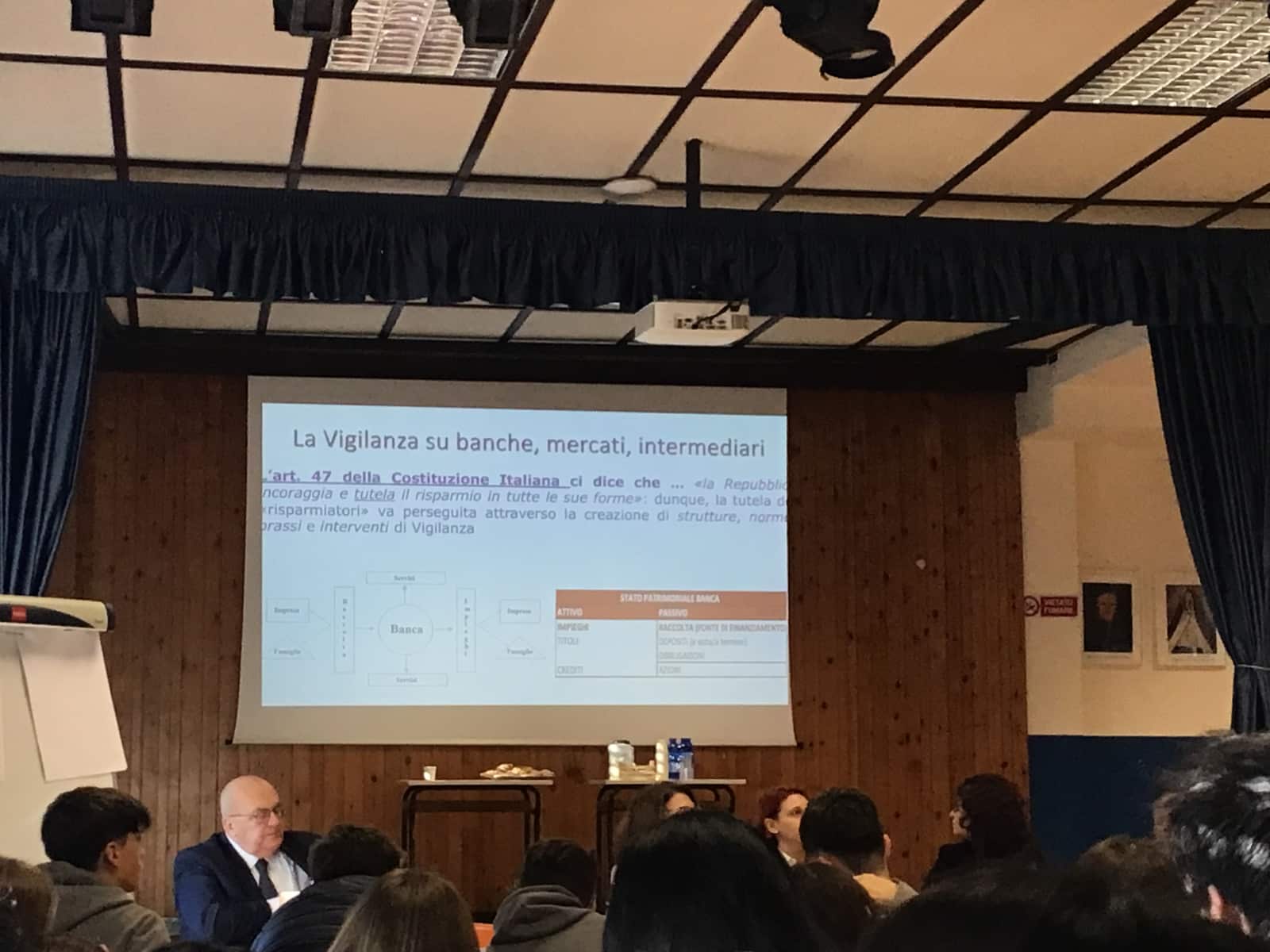
“They call it the dismal science, but we are here to show you that things are not exactly like that”: with these words Pietro Gaudenzi, Head of the School-Work Section of the Bank of Italy, immediately stated the ambitious task of his delegation when, on January 22, he met us in the Great Hall of our High School on the occasion of the “break from regular classes,” a week in which the school involved students in original, cross-disciplinary lessons, often given by outside experts as in this case.
An important guidance opportunity during which we were able to deepen our knowledge of the main public institution that acts to safeguard the country’s finances: “The Bank of Italy is the central bank of the Italian Republic, it pursues purposes of general Italian and European interest, overseeing the relationships between commercial banks and private individuals, contributing to monetary policy decisions and providing financial education to all citizens,” explained Dr. Marco Rotili, of the Adults and School-Work division, during his talk. “All the activities carried out by this body influence important factors of the economy and finance, such as inflation or the circulation of money, in Italy and in Europe, and this very fact demonstrates its decisive and strategic role.”
The meeting, during which the Pathways for Transversal Skills and Orientation (PCTO) active throughout the country were also presented, was then the occasion to prepare what twelve students of our school will begin next March 4 at the Historical Archive, near Via Nazionale. Under the guidance of Irene Guerriero (PCTO tutor), Debora Chiarelli (PCTO co-tutor), and Giuseppe Luci (PCTO collaborator), our classmates will have the chance to work for five days side by side with the specialists who look after the precious documentary heritage of Palazzo Koch and, as they see their transversal skills mature, they will also breathe the air of a prestigious working environment.
Dr. Carola Carlizza, of the Adults and School-Work Division, then provided information and valuable advice on the path to follow should one decide to try to join the Bank of Italy, illustrating the competitive-exam mechanisms, the career paths, and the requirements one must meet; among these are mastery of English (at a level equal to or above B2), a three-year bachelor’s degree in programs such as Law, Economics, Finance, Statistics, or Political Science and, for more important positions, also a graduate degree, a master’s, or a doctorate. Her talk conveyed to the students a rather dynamic view of the work environment at the Bank of Italy, making them understand, for example, that an economics-and-finance curriculum is not the only possible one and that disciplines such as law or STEM (Science, Technology, Engineering, and Mathematics) can also be a stepping stone to a career within the walls of Palazzo Koch and its offices throughout Italy.
It was a very interactive presentation: the students had the opportunity to ask questions to clear up their doubts and, at the end of the talks, were involved in a debate on current topics such as bitcoin and cryptocurrencies. This exchange of ideas allowed us to explore topics that are becoming ever more important given the advance of technology and innovation, because it is of fundamental importance to have a general culture that allows us to build our own criteria for choice and analysis when facing the different situations and problems of daily life.
We hope that the school will intensify its dialogue with specialized professionals such as those we met during this meeting, so as to stimulate our talents and give us a less abstract idea of the jobs we will choose in the future. Our desire to emancipate ourselves is also nourished by experiences like this one.
By Emma Costantini and Ottavia Costantini, 17 years old, IV A Classical (journalism workshop)