

· News
Teaching and journalism: "Write little, but write clearly"
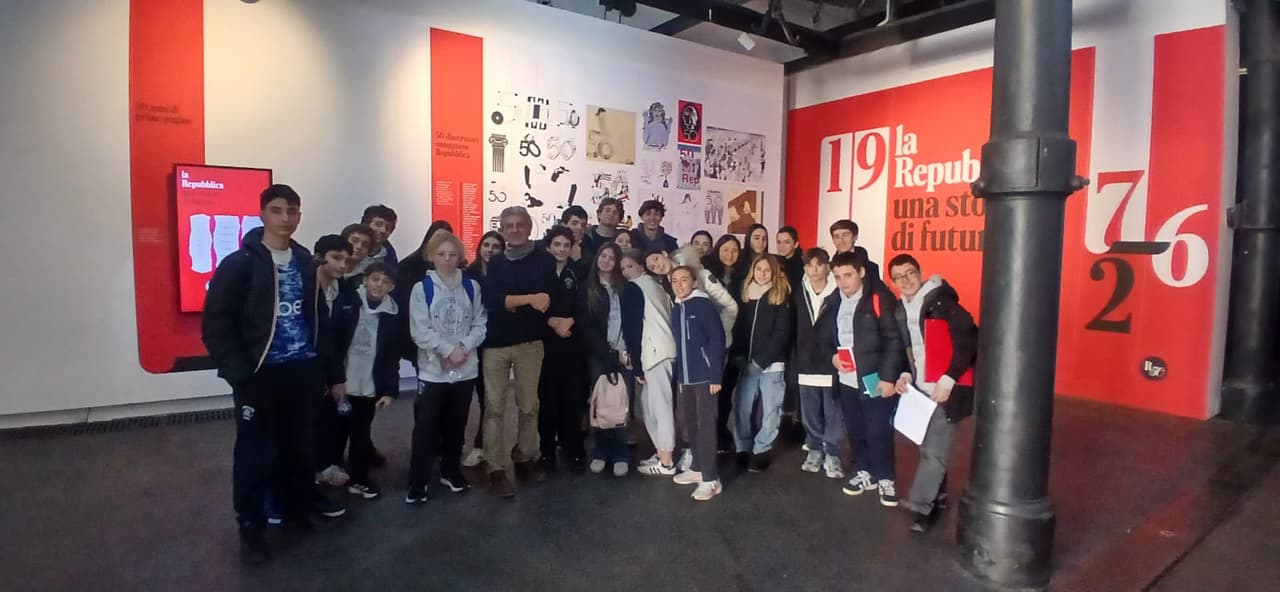
Here is the style principle that will stay etched in the minds of the young reporters of the Marymount Express after their visit to the exhibition for the 50th anniversary of the newspaper la Repubblica at the Mattatoio. What excited them most during this experience we leave to them to tell, in this preview of the next issue of the paper, in which we offer Pietro’s first impressions and Nicola’s interview with journalist Angelo Melone, who patiently guided us through the front pages that mirror half a century of our history. By the way, the exhibition will remain open until March 15, and the Marymount Express strongly recommends not missing it!
1976-2026. La Repubblica. Una storia di futuro, review by Pietro Luti, second-year Middle School, class C
Let no one ever think that embarking on a path always means seeing it through to the end. Honestly, that is what I thought as I lay down in my bed at the end of yesterday, after one of the best visits I have ever made. Journalism is not something that suits only those who have a natural talent for it. And yesterday proved it. Everyone, or nearly everyone, I am sure, would have appreciated the welcome of Mr. Angelo Melone (our accompanying journalist), his way of explaining and answering openly, without showing the slightest annoyance, all our endless questions, but also seeing how, over the years, a small newsroom has evolved so incredibly.
Many would also have appreciated the display at the entrance where, by entering the day, month and year of your birth, you could view the front page of the newspaper from that day. Many moments in Italian history, and beyond, that have marked, mark and will mark generations, we saw summarized in less than a page. A kind of magic. And, in my opinion, the point is made even clearer this way because, as our guide said, writing little but clearly is much harder than writing a lot.
All in all, it was one of those experiences that can be lived in different ways but, and of this much I am certain, the quality of what we saw, heard and, for many of us, appreciated is something that should be experienced at least once in a lifetime.
Interview with Angelo Melone by Nicola Lopilato, second-year Middle School, class D
Was La Repubblica an immediate success?
No, in its first two years it came close to shutting down.
So what then convinced people to buy la Repubblica and not other newspapers?
Probably its unique language: to best interpret the topics covered by Repubblica, the reader has to be already informed about the issues covered; readers were looking for opinions, not simply facts.
Did color printing change the style of the images?
Yes, profoundly. Color printing made it possible to change the content of the images a great deal, making them more vivid.
Why is it called la Repubblica?
Probably because it is what united the journalists who founded it: a strong republican creed.
What is Repubblica’s main source?
There are many, such as the web, but there you have to check whether the news is true or not; in fact there is a department of journalists who do exactly this, fact-checking. However, the main source remains the press agencies.
What was the darkest moment in your history?
Probably the kidnapping of Daniele Mastrogiacomo. They were 14 very dark days for us.