

· News
"Being Inspired by Love in Life": reflections on the sidelines of the Béziers Experience
We are increasingly inclined to think that academic excellence is exclusively a synonym for competition, individualism, and personal fulfillment, but there is a deeper meaning that every Marymount teacher and educator keeps clearly in mind: education cannot be separated from the social reality in which students live, and knowing the world also means, inevitably, learning to recognize its inequalities, injustices, and contradictions, while developing the tools to face them.
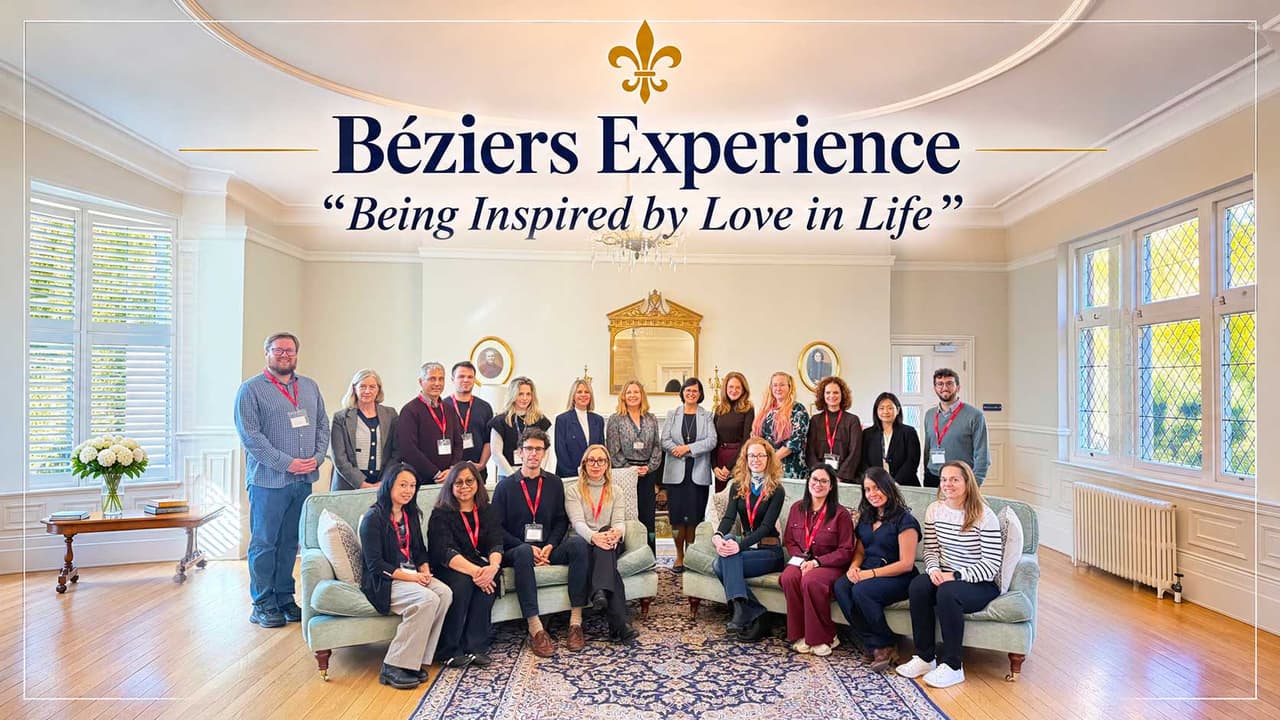
These were the themes at the heart of the meeting that, in mid-October, brought together in London the teachers of the European schools of the RSHM network for the Béziers Experience, a time of discussion and training devoted to the roots of the congregation’s charism and its relevance today in the world of education. From social justice to creativity, from gratitude to responsibility toward others, the reflection was guided by Sister Luisa Maria Almendra, who accompanied the teachers on a path devoted to the meaning of inspiration, the search for beauty in everyday life, and the possibility of contributing, through one’s own work, to improving society.
“We reflected a great deal on the importance of love and action, on how to turn our inspiration into practical actions through creativity, gratitude, and justice,” explains Professor Morettini, teacher of English Literature and Political History in our High School. “The shift from idea to action was one of the central themes to emerge during the meeting, because inspiration is not only about what one thinks or desires, but requires a willingness to question oneself, to let oneself be changed, and to translate one’s values into concrete behavior.”
A concept that also resonated particularly in the reflection of Michela Dell’Orco, English teacher in the Middle School, who was struck precisely by the distinction between inspiration and motivation: “The idea that inspiration is not motivation and that, on its own, it is not enough made me think a lot. Inspiration has to turn into action. In our work we see it every day: a student can be fascinated by something, but only through practice, and then habit, does that spark become part of them. This makes me realize how important it is to accompany the students along the way, without stopping at enthusiasm alone.” A consideration that brings us back to the heart of educational responsibility: it is not enough to spark interest; we must help students turn it into awareness, behaviors, and choices.
“Attention to the most vulnerable people, to those who live on the margins of society, is a distinctive element of the educational project of Father Gailhac and the founding Mothers,” adds Morettini. “From the first works of assistance to women in fragile conditions and to orphans, to the various forms of social service present in the world today, the same inspiration has translated into different responses to the needs of communities. The Sisters present in the different countries each have a particular concern for the marginalized and for people without a voice. I would like to mention, for example, the experience of the Sisters who in the United States offer free legal counsel to migrants or accompany people and their families at the end of life, including through their presence in hospitals.” Different experiences, then, united by the desire to respond concretely to people’s needs and to recognize, especially in situations of greatest vulnerability, the value of solidarity, closeness, and human dignity. A reflection that closely concerns the role of teachers, since to educate means to transmit knowledge, but also to bear witness, through one’s own choices, to the possibility of building fairer relationships, contributing to the common good.
Alongside the reflection on values, the days in London were also an important opportunity to rediscover the history and common roots of the RSHM schools. Sister Luisa guided the teachers in an in-depth exploration that, starting from the origins of the congregation with Father Gailhac in Béziers, France, came all the way to the present day. A path that allowed them to better understand how the history of the RSHM continues to live on in the different educational communities and in the Sisters’ works around the world. “I had never really paused over the fact that Father Gailhac was a teacher,” Michela Dell’Orco says again. “Knowing that the spirit of our community was born precisely from school makes me feel even more involved.” A link between history and educational identity that also emerges through the resources made available by the congregation, such as the RSHM YouTube channel which, for example, collects videos devoted to the history and values of the institute, as well as the series Meet the Sisters, which presents some of the Sisters and their work in the contemporary world.
The opportunity for discussion and sharing was, moreover, particularly appreciated by the participants. “One of the things I liked most about this experience was the chance to talk with Marymount colleagues from other schools, but also with those from my own school,” observes Haley Richard, English teacher in Early Childhood. “Working with the little ones in EC1 and EC2, I don’t often get to talk with Middle School or High School teachers, so it was really nice to get to know these colleagues both personally and to discover the work they do professionally.” Anything but a minor point, because building an educational community also means overcoming the distances between the different school levels, sharing experiences, and recognizing each person’s contribution to the students’ growth.
The same teacher passes on to us some meaningful practical proposals that emerged during the meeting: “As part of the experience, Sister Luisa gave us time to discuss how to bring into our schools, together with our colleagues, the same inspiration that guided Father Gailhac. We thought about creating an illustrated book that tells the history and values of the RSHM, made by the older students for the younger ones, and a newspaper article written by the High School students to share with the school community.”
The London meeting thus offered the teachers of the RSHM schools a space to come together, get to know each other better, and share the questions that run through the teaching profession, but it also served as a reminder that the charism of a school community does not live only in its history or in the principles that define it, but takes shape in relationships, in teaching choices, and in the opportunities offered to students, continuing to live on as an orientation able to give meaning to both teaching and learning, that all may have life.