

· Middle School
Apprentice Philosophers at the Middle School!
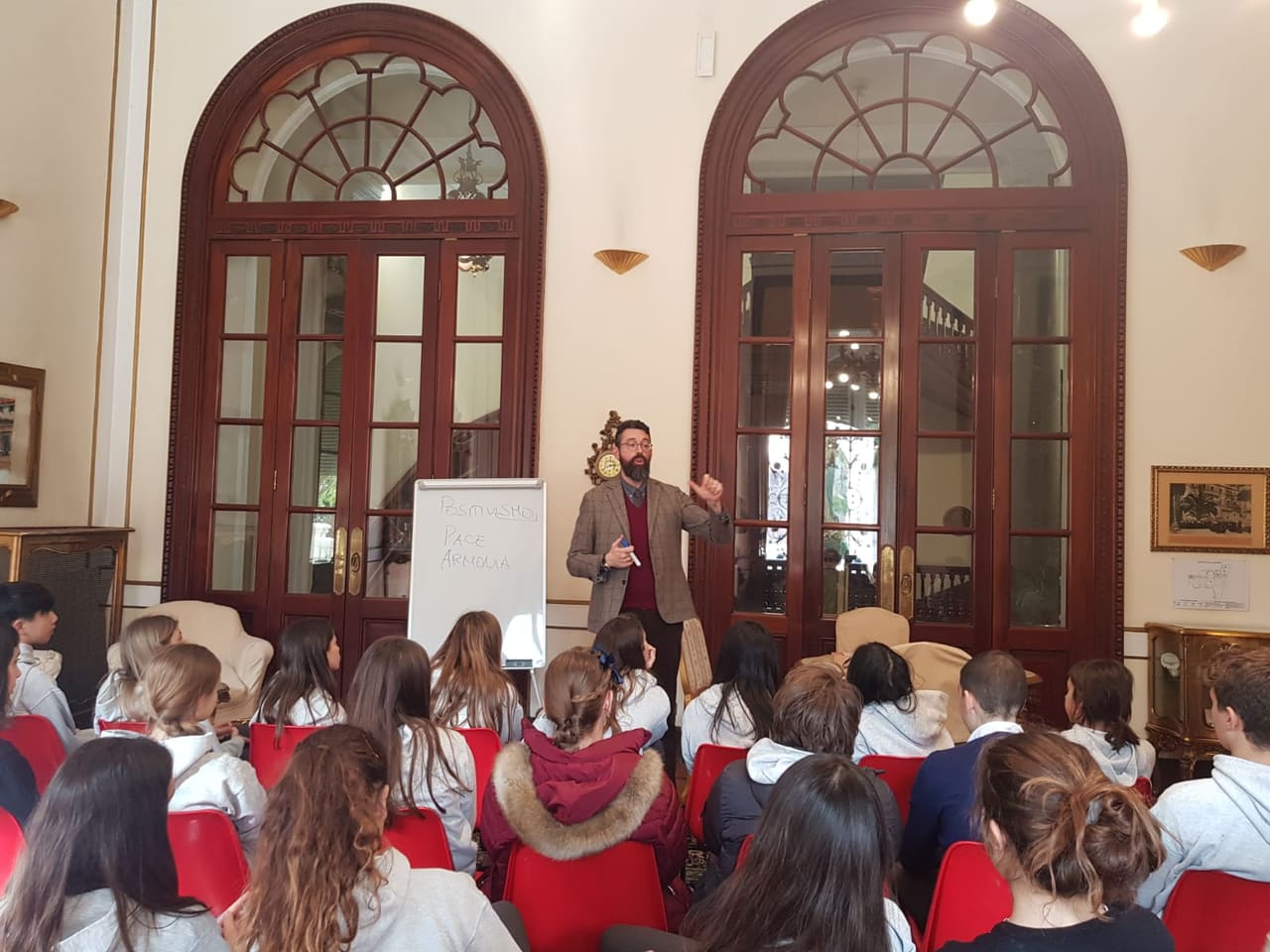
The philosophy sessions continue for our Middle School students: after the lecture by Prof. Nicola Zippel, we talked about Positivism and society with Prof. Matteo Mauro, a teacher at the “Marymount” High School. Here is an account by one of our students.
It was a rather unusual afternoon last Tuesday, March 4, for our three classes, IIIA, IIIB, and IIIC, before the usual life of our school was interrupted by the emergency of these days. Prof. Matteo Mauro, a teacher of History and Philosophy at the Marymount High School, came to give us a lesson on one of the endlessly debated themes of philosophers: Positivism, a topic that we are approaching from the point of view of the history of literature. Before going into detail, and starting to “tangle ourselves up” in almost extravagant thoughts, the professor explained the etymology of the word to us. It can be divided into two parts: “positiv-” and the suffix “-ism”; the first fragment of the word alludes to the infinite improvement toward which the founding philosophers of this current in the early nineteenth century, Comte and Saint-Simon, thought human evolution tended; “-ism,” on the other hand, more simply means a set of thoughts, so one could conclude that Positivism always aspires to what is, precisely, positive.
Secondly, the professor linked back to causality, that is, to the fact that in the Positivist view every action necessarily had to correspond to an effect, also in the human sciences, and not only in mathematics and geometry. Therefore, in the Positivist society everything should have been perfect, but not an approximate kind of perfect, rather a scientific and precise one, based on Newton’s laws and on the set of laws of social phenomena that is defined as “social physics.”
Finally, the professor gave us an example of how Positivism found applications even in the landscape, citing the example of the town of Crespi D’Adda, an industrial village in northern Italy built following a very orderly and rational layout, and showing us the contrast with a neighborhood of our city, Trastevere, where instead the houses were built in a circular arrangement around the church, to emphasize also the fact that God was at the center of everything (but this then caused disorder).
To conclude, the professor insisted on the limits of Positivism in society, because it looks at only one side of the coin, exalting scientific progress without taking other factors into account.
Ottavia Costantini, Class III C, Middle School